The effect of creativity fostering teacher behaviors on student creative thinking: The mediating role of creative mindsets
- Field
- Educational Psychology
- Kind
- Research paper
- Words
- 6,015
- Reading
- 26 min
Abstract: Teachers play a critical role in the development of student creativity, and their effectiveness in this role depends on whether they exhibit creativity-supportive behaviors in the classroom. Some prior studies have examined the link between these behaviors and student creative performance, yet the underlying mechanisms remain unclear. Grounded in social cognitive theory, this study investigated how teacher behaviors might influence students’ creative thinking and explored the mediating role of creative mindsets (i.e., malleable vs. fixed mindset). Creative thinking was assessed from three dimensions in this study: generating diverse ideas, generating creative ideas, as well as evaluating and improving ideas. A sample of 76 Chinese high school students participated in this study. The mediation analyses results indicated that overall teacher behaviors positively influenced students’ creative thinking, yet the pathways via creative mindsets varied across the three dimensions of creative thinking. These findings may offer practical insights for educators to design and implement effective pedagogical strategies aimed at improving students’ creative thinking.
Keywords: Creativity fostering teacher behaviors; Creative thinking; Creative mindsets; Chinese students
1. Introduction
Creative thinking, defined as “the competence to engage productively in the generation, evaluation, and improvement of ideas, that can result in original and effective solutions, advances in knowledge, and impactful expressions of imagination” (Organization for Economic Cooperation and Development, 2023), has emerged as a pivotal competency for 21st century students. Many education systems worldwide have integrated creative thinking into their pre-tertiary curricula (Shi et al., 2016), and prioritized strategies to enhance students’ creative capabilities (Soh, 2017).
Among the myriad factors shaping students’ creative development, teacher behaviors stand out as a critical determinant, given teachers’ ability to elicit, guide, and support students’ creativity (Besançon & Lubart, 2008; Diakidoy & Kanari, 1999; Du et al., 2019). For example, Torrance (1979) proposed three specific teacher behaviors that may foster students’ creativity: heightening anticipation, deepening expectations, and extending the learning. Wang et al. (2024) demonstrated that certain teacher behaviors (e.g., encouraging flexible thinking, delayed judgements) exerted significant and positive effects on students’ creative problem-solving skills, as evidenced by both subjective and objective creativity assessments.
While some prior studies have established the link between teacher behaviors and students’ creative thinking, three major research gaps persist. First, the underlying pathways linking teacher behaviors to students’ creative thinking remain unexplored. In particular, researchers have highlighted the need for further investigation into the mediating role of creative mindsets – a construct reflecting individuals’ beliefs about whether creativity is malleable or fixed (Emami et al., 2023; Hua & Yang, 2024; He & Chiang, 2024). Second, creative thinking has been treated as a unitary concept in some prior studies (e.g., Sue-Chan & Hempel, 2016), which overlooked the multidimensional nature of creative thinking that includes both divergent and convergent thinking processes (Plucker & Makel, 2010). This oversimplification may obscure potential differential effects of teacher behaviors on these distinct creative processes (Ma & Corter, 2019). Third, research suggests that high school is a critical period for the rapid development of students’ creativity (Hu & Adey, 2002; Klijn & Tomic, 2010; Newton & Newton, 2014). However, most prior studies have focused on primary and middle school students (e.g., Yi, Hu, Plucker, & McWilliams, 2013; Russ & Fiorelli, 2010; Alfonso-Benlliure & Santos, 2016), leaving a gap in understanding creative thinking during adolescence.
To address these gaps, the present study was designed to investigate how teacher behaviors may differentially influence distinct aspects of creative thinking, and to explore whether creative mindsets mediate these relationships among Chinese high school students.
2. Literature Review
2.1 Creativity fostering teacher behaviors and students’ creative thinking
According to the bioecological systems model of human development by Bronfenbrenner (1979), the development of children is jointly determined by a primary context where they observe and engage in activities under the guidance of another person, and a secondary context where resources, opportunities, and encouragement to perform activities are provided to them (Bronfenbrenner & Ceci, 1994; Bronfenbrenner & Morris, 2006). From this bioecological view, teacher behaviors are argued to be an important factor in students’ creativity development (Bronfenbrenner & Cici, 1994; Bronfenbrenner & Morris, 2006). This is because students are able to routinely observe and engage in creative activities under the guidance of their teachers, who subsequently give students the opportunity, resources and encouragement to explore the unknown and promote their creative thinking. In other words, the guidance and support from teachers respectively comprise the primary and secondary developmental contexts for students.
In fact, researchers have attempted to explore, both theoretically and empirically, the associations between teacher behaviors and students’ creative performance. For example, Cropley (1995) listed nine conditions necessary for teachers to foster students’ creativity, i.e., encouraging students to learn independently, having a cooperative, socially integrative style of teaching, motivating students to master factual knowledge, delaying judging students’ ideas until they have been thoroughly worked out and clearly formulated, encouraging flexible thinking, promoting self-evaluation in students, taking students’ suggestions and questions seriously, offering students opportunities to work with a wide variety of materials and under many different conditions, and helping students to learn to cope with frustration and failure. Zhang and Chi (2025) found that humble teacher leadership (e.g., understanding students’ strengths and weaknesses, accepting students’ new thoughts and methods, be willing to listen to students and encouraging questions) significantly enhanced students’ creative process engagement among 384 Chinese college students. Building on these previous studies, the following hypothesis was formulated:
Hypothesis 1: Creativity fostering teacher behaviors would positively relate to students’ creative thinking.
2.2 Creative mindsets and creative thinking
Individuals with a creativity-oriented and growth-focused mindset view creativity as a skill that can be developed through experience and guidance. They recognize the malleability of creativity and believe that their creative capacity can be enhanced through deliberate efforts (Fleck & Asmuth, 2021). In contrast, those with a fixed mindset tend to perceive their creative capability as innate and unchangeable. When faced with challenging tasks that push the boundaries of their perceived abilities, they may experience frustration or helplessness (Dweck, 1986, 1989; Dweck & Leggett, 1988; King, 2012). Notably, no consensus currently exists on whether the two types of mindsets – malleable and fixed – are two ends of one continuum (i.e., unidimensional, Dweck, 2000) or if they are independent constructs (Luftenegger & Chen, 2017; Tempelaar et al., 2015; Alvarado et al., 2024). In line with recent empirical studies (e.g., Alvarado et al., 2024; Yeh et al., 2023), the present study adopted a multidimensional approach, operationalizing these mindsets as separate constructs and employing distinct items to measure each construct rather than reverse coding the malleable mindset items to assess fixed mindset (DeVellis, 2016).
The relationship between individuals’ mindsets and creative performance has been well-documented in the literature. For example, Makel (2009) and O’Connor et al. (2013) found that individuals with malleable mindsets tended to demonstrate greater creative achievement and problem-solving abilities than those with fixed mindsets. Similarly, Choi et al. (2020) revealed that adopting a growth mindset enhanced individuals’ creative performance by increasing their willingness to engage in creative activities and devise innovative solutions. Karwowski (2014) further demonstrated that a malleable creative mindset positively predicted insight problem-solving performance, creative self-efficacy and creative self-identity, whereas a fixed mindset negatively related to these outcomes. Building on these prior findings, the following hypotheses were formulated:
Hypothesis 2a: A malleable mindset would positively relate to student creative thinking;
Hypothesis 2b: A fixed mindset would negatively relate to student creative thinking.
2.3 The indirect effect of creative mindsets in the relationship between teacher behavior and student creative thinking
The social cognitive theory (Bandura, 1977, 2023) posits that learning occurs in a social context with dynamic and reciprocal interactions among the person, environment and behavior. Applied to implicit theories of creativity, it suggests that individuals’ beliefs about their abilities – including creative thinking – are shaped by these interactions (Abedini et al., 2023), and further these beliefs can serve as guiding principles that influence individuals’ motivational and behavioral outcomes (Rad et al., 2023; Hamann et al., 2024).
In creativity research, the social cognitive theory implies that environmental factors – such as classroom teacher behaviors – can shape individuals’ creativity-related motivation and beliefs (e.g., creative mindsets), thereby enhancing or hindering their creative performance. Supporting this view, Du et al. (2019) found that students’ intrinsic motivation mediated the relationship between teacher behaviors and students’ creative achievement, particularly for students with high levels of openness to experience. Liu, Shah and Shoaib (2024) examined the relationship between creative leadership, creative mindset, self-regulatory focus, and employee creativity among 389 service-sector employees. Their results indicated that creative leadership positively influenced employee creativity, mediated by creative mindsets and self-regulatory focus. Building on the prior research, the following hypotheses were formulated:
Hypothesis 3a: Creativity fostering teacher behaviors would positively influence creative thinking through the mediation of a malleable mindset.
Hypothesis 3b: Creativity fostering teacher behaviors will negatively influence creative thinking through the mediation of a fixed mindset.
3. Methods
3.1 Participants
A sample of 76 high school students from Shanghai of China participated in this study. Of them, twenty-nine were male students (38.2%), forty-seven were female students (61.8%). Forty-three of them were 10th graders (56.6%), seventeen were 11th graders (22.4%), and sixteen were 12th graders (21.1%).
3.2 Measures
Creativity fostering teacher behaviors. Teacher behaviors that foster creativity were assessed using the Creativity Fostering Teacher Behavior Scale (CFTB; Soh, 2017). Four dimensions of teacher behaviors were measured in this study, each comprising four items rated on a 5-point Likert scale, with 1= strongly disagree, 2 = disagree, 3 = neutral, 4 = agree, and 5 = strongly agree. The four dimensions were: 1) Independence, the extent to which teachers encourage autonomous learning. Example items are “My teacher encourages students to show what they have learned on their own” and “My teacher leaves problems for students to solve on their own”; 2) Flexible thinking, the degree to which teachers promote diverse perspectives. Example items are “My teacher appreciates students taking time to think from different perspectives” and “My teacher encourages students to ask questions freely, even if sometimes they seem irrelevant”; 3) Question, indicating how seriously teachers considers students’ suggestions and questions. Example items are “My teacher listens carefully when students raise questions” and “My teacher does not easily dismiss students’ suggestions”; 4) Judgement, indicating whether teacher delays evaluating students’ ideas until they have been thoroughly worked out and clearly formulated. Example items are “When students have some ideas, my teacher gets them to explore further before taking a stand” and “My teacher provides students feedback by asking follow-up questions to promote their deep thinking”. The Cronbach’s alpha of this scale was 0.95.
Creative mindsets. Creative mindsets were measured using the Creativity Mindset Inventory (CMI; Yeh et al., 2023). Two distinct dimensions of creative mindsets were assessed in this study, i.e., a malleable mindset (belief in the developability of creativity) and a fixed mindset (belief in creativity as an innate trait). Each dimension comprised six items rated on a 5-point Likert scale, with 1= strongly disagree, 2 = disagree, 3 = neutral, 4 = agree, and 5 = strongly agree. Example items for a malleable mindset were “I can be more creative as long as I am willing to learn” and “My creativity can be substantially improved when I have sufficient learning opportunities”. Example items for a fixed mindset were “Even if I work hard by myself, my creativity won’t be substantially improved” and “Even if there is someone to tutor me, it’s hard for me to become more creative”. The Cronbach’s alpha of the scale was 0.89.
Creative Thinking. Creative thinking was assessed using two creative problem-solving tasks from the Program for International Student Assessment (PISA 2022), i.e., “Save the Bees” and “Save the River” (see more details about the tasks at https://www.oecd.org/en/about/programmes/pisa/pisa-2022-creative-thinking-test-questions.html). Creative thinking was specified in terms of three dimensions (PISA 2022): 1) Generating diverse ideas, which refers to a student’s capacity to think flexibly by generating multiple distinct ideas. Test items for this dimension present students with a stimulus and ask them to generate two or three appropriate ideas in response that are as different as possible from one another, e.g., “Suggest concrete actions “save the bees” club can take to help others become more aware of the issue”; 2) Generating creative ideas, which focuses on a student’s capacity to generate appropriate and original ideas. Test items for this dimension present students with a stimulus and ask them to develop one original idea in response, e.g., “Suggest an original idea that could be used to increase awareness about the importance of the bees”; and 3) Evaluating and improving ideas, which focuses on a student’s capacity to evaluate limitations in ideas and improve their originality. Test items for this dimension present students with a given scenario and idea and ask them to suggest an original improvement in response, e.g., “Think of a way to improve the experiment to help the lab team to gain more conclusive evidence in order to know if chemical pollution is the cause of the problem with the frogs”.
3.3 Procedure
Participants in this study completed the study through an online survey platform (Wenjuanxing). They were asked to first work on two creative thinking tasks, followed by questionnaires that assess their creative mindsets and perceptions of teacher behaviors. The entire procedure required approximately 30 minutes to complete. Prior to data collection, all participants were informed that their participation was voluntary and anonymous. They were notified that they could withdraw from the project at any time without giving any reason, and their information would be kept in confidentiality.
3.4 Data analysis
Data were analyzed in SPSS 28.0. Preliminary analyses of the data, including descriptive statistics and zero-order correlations, were first performed. To test the hypotheses, linear regression with mediation analyses were then utilized.
4. Results
4.1 Descriptive statistics
Table 1 presents the means, standard deviations, and correlations of the studied variables. As shown, a malleable mindset was significantly and positively related to creativity fostering teacher behaviors (r teacher behaviors = 0.627, p < 0.01) and two dimensions of creative thinking as well as the overall score (r generate diverse ideas = 0.229, p < 0.05; r generate creative ideas = 0.272, p < 0.05; r overall creative thinking score = 0.327, p < 0.01). A fixed mindset was significantly and negatively related to creativity fostering behaviors (r teacher behaviors = -0.288, p < 0.05), yet no significant correlations were found between a fixed mindset and creativity-related variables (p > 0.05).
| M | SD | 1 | 2 | 3 | 4 | 5 | 6 | |
|---|---|---|---|---|---|---|---|---|
| 1. Teacher behaviors | 3.57 | 0.97 | / | |||||
| 2. Malleable mindset | 21.53 | 5.82 | 0.627** | / | ||||
| 3. Fixed mindset | 18.72 | 6.98 | -0.288* | -0.322** | / | |||
| 4. Generate diverse ideas | 3.11 | 1.03 | 0.022 | 0.229* | -0.182 | / | ||
| 5. Generate creative ideas | 2.92 | 0.84 | 0.337** | 0.272* | -0.041 | 0.148 | / | |
| 6. Evaluate and improve ideas | 1.18 | 0.58 | 0.077 | 0.125 | 0.020 | 0.212 | 0.084 | / |
| 7. Overall creative thinking | 7.21 | 1.64 | 0.214 | 0.327** | -0.128 | 0.776** | 0.636** | 0.530** |
Notes: M = Mean, SD = Standard Deviation; *p < 0.05; ** p < 0.01.
4.2 Teacher behaviors, creative mindsets and creative thinking
To examine whether creative mindsets (i.e., a malleable vs. fixed mindset) serve as mediators between teacher behaviors and creative thinking, we used Preacher and Hayes’ (2004) SPSS macro to estimate indirect effects within each mediation model, based on 5000 randomly selected subsamples for each model and with 95% bias-corrected confidence intervals. Separate mediation models were built for both the overall score of creative thinking and its three specific dimensions.
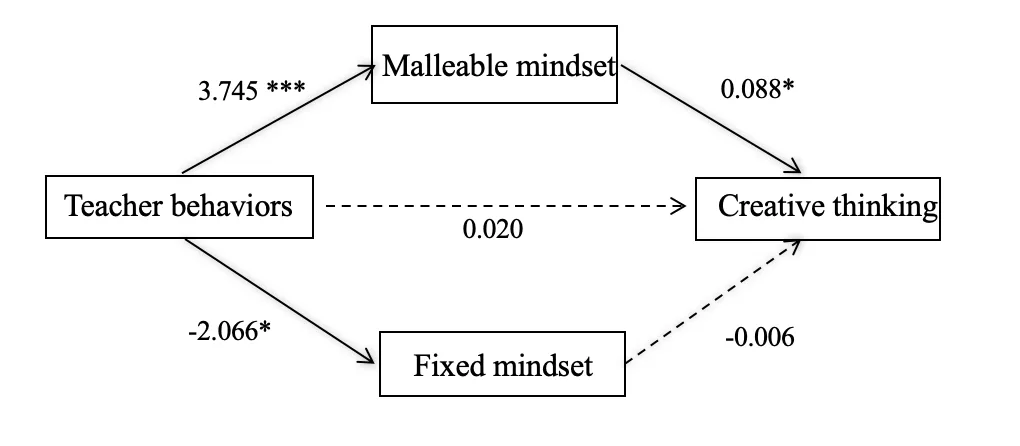
First, the mediation model results for the overall score of creative thinking were presented in Table 2 and Figure 1. As seen, the direct effect of teacher behaviors on creative thinking was not significant (β = 0.020, t = 0.080, p = 0.936 > 0.05). However, teacher behaviors significantly predicted malleable mindsets (β = 3.745, t = 6.915, p < 0.001), which in turn positively predicted creative thinking (β = 0.088, t = 2.144, p = 0.035 < 0.05). Bootstrapping analyses also showed that the unstandardized indirect effect through malleable mindsets was significant (effect size = 0.330) with 95% confidence intervals (CIs) ranging from 0.036 to 0.730, supporting the hypothesis that teacher behaviors exerted an indirect effect on creative thinking through a malleable mindset. By contrast, the indirect effect through a fixed mindset was not significant (effect size = 0.012, 95% CIs = -0.082 to 0.203). The above findings supported a full mediation model, indicating that teacher behaviors influenced creative thinking primarily through fostering students’ malleable mindsets rather than inhibiting their fixed mindsets.
| Effect size | SE | LLCI | ULCI | |
|---|---|---|---|---|
| Direct effect | ||||
| Teacher behaviors → Overall creative thinking | 0.020 | 0.243 | -0.465 | 0.504 |
| Indirect effects | ||||
| Teacher behaviors → Malleable mindset → Overall creative thinking | 0.330 | 0.177 | 0.036 | 0.730 |
| Teacher behaviors → Fixed mindset → Overall creative thinking | 0.012 | 0.070 | -0.082 | 0.203 |
| Total effects | 0.361 | 0.192 | -0.021 | 0.744 |
Notes: SE = standard error; LLCI = Lower limits of confidence interval; ULCI = Upper limits of confidence interval.
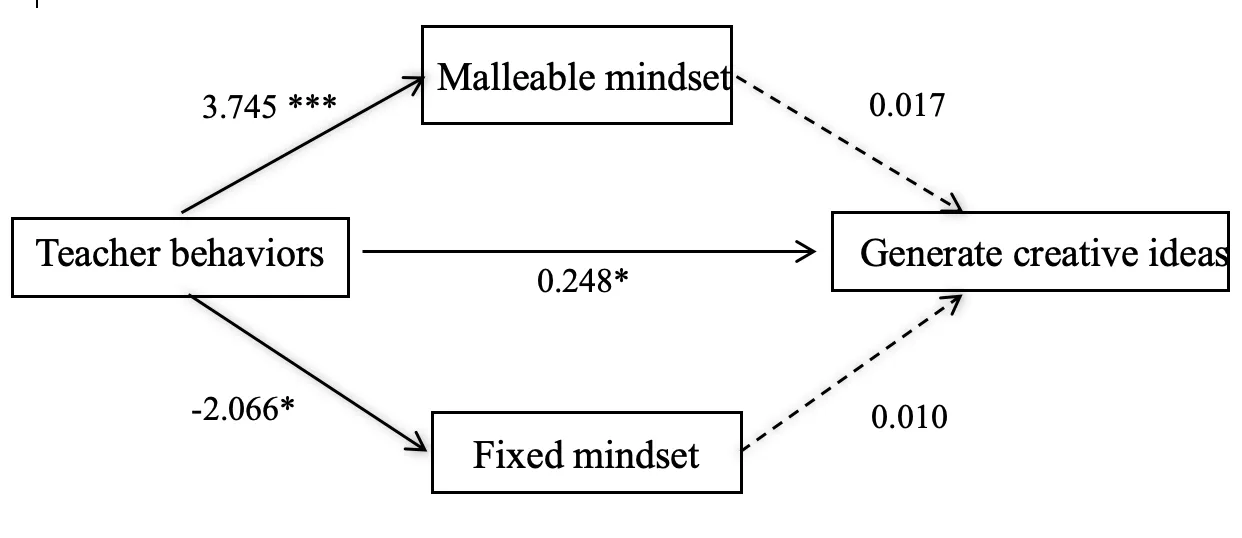
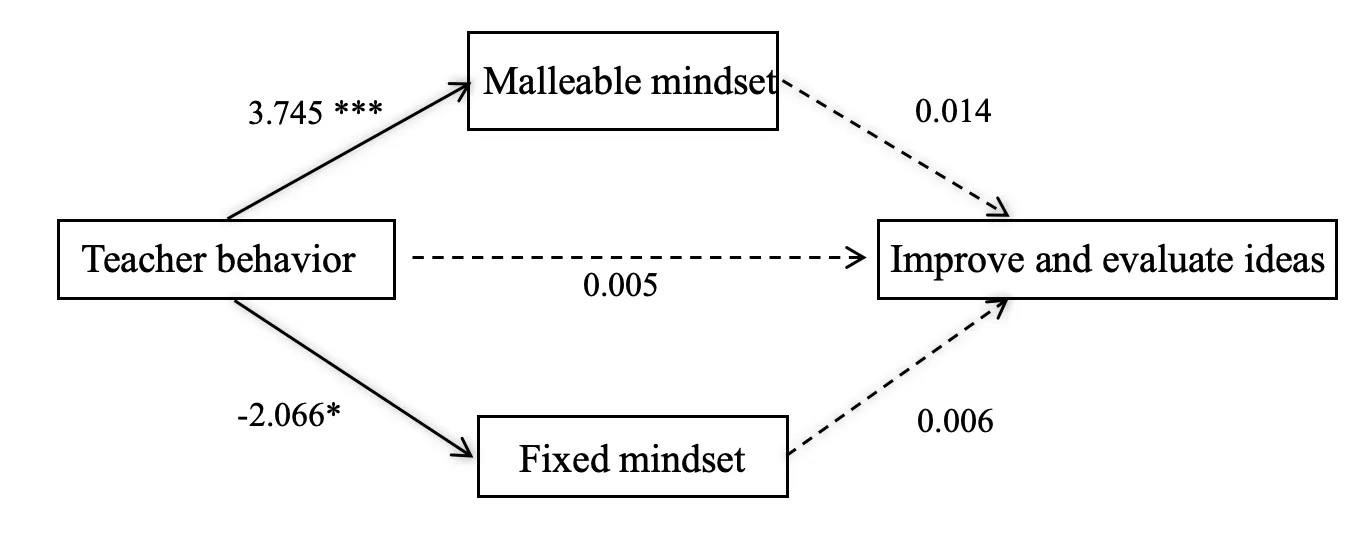
Furthermore, the mediation model results for the three specific dimensions of creative thinking (i.e., generating diverse ideas, generating creative ideas, evaluating and improving ideas) were presented in Table 3 and Figure 2-4.
| Effect Size | SE | 95% CI | ||
|---|---|---|---|---|
| Generate diverse ideas | ||||
| Direct effect | Teacher behaviors → Generate diverse ideas | -0.233 | 0.153 | [-0.538, 0.071] |
| Indirect effects | Teacher behaviors → Malleable mindset → Generate diverse ideas | 0.213 | 0.125 | [0.006, 0.491] |
| Teacher behaviors → Fixed mindset → Generate diverse ideas | 0.043 | 0.057 | [-0.020, 0.192] | |
| Total effects | 0.023 | 0.123 | [-0.222, 0.267] | |
| Generate creative ideas | ||||
| Direct effect | Teacher behavior → Generate creative ideas | 0.248 | 0.124 | [0.002, 0.495] |
| Indirect effects | Teacher behaviors → Malleable mindset → Generate creative ideas | 0.064 | 0.080 | [-0.100, 0.223] |
| Teacher behaviors → Fixed mindset → Generate creative ideas | -0.020 | 0.036 | [-0.090, 0.061] | |
| Total effect | 0.293 | 0.095 | [0.104, 0.482] | |
| Evaluate and improve ideas | ||||
| Direct effect | Teacher behavior → Evaluate and improve ideas | 0.005 | 0.090 | [-0.175, 0.184] |
| Indirect effects | Teacher behaviors → Malleable mindset → Evaluate and improve ideas | 0.053 | 0.060 | [-0.053, 0.185] |
| Teacher behaviors → Fixed mindset → Evaluate and improve ideas | -0.012 | 0.023 | [-0.065, 0.031] | |
| Total effects | 0.046 | 0.069 | [-0.092, 0.184] | |
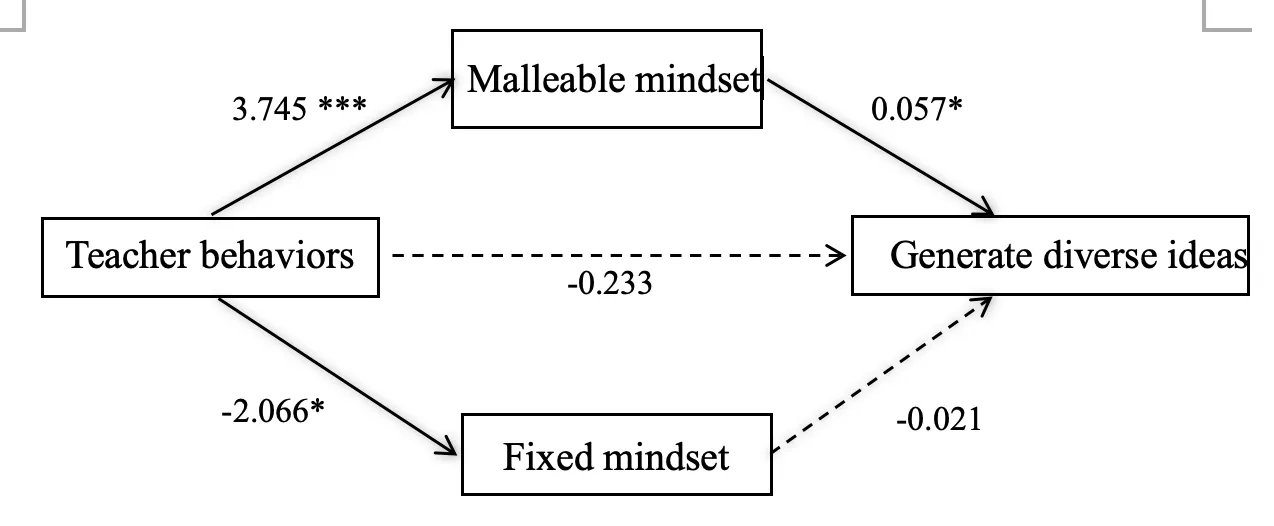
Specifically, for generating diverse ideas, the direct effect of teacher behaviors was not significant (β = -0.233, t = -1.527, p = 0.131 > 0.05). However, bootstrapping analyses showed that the unstandardized indirect effect through malleable mindsets was significant (effect size = 0.213) with 95% confidence intervals (CIs) ranging from 0.006 to 0.491, supporting the hypothesis that teacher behaviors exerted an indirect effect on generating diverse ideas through malleable mindsets. By contrast, the indirect effect through fixed mindsets was not significant (effect size = 0.043, 95% CIs = -0.020 to 0.192). These findings supported a full mediation model, indicating that teacher behaviors influenced students’ ability to generate diverse ideas primarily through fostering malleable mindsets rather than inhibiting fixed mindsets.
For generating creative ideas, the direct effect of teacher behaviors was significant (β = 0.248, t = 2.010, p = 0.048 < 0.05). Bootstrapping analyses showed that the unstandardized effect through either malleable or fixed mindsets were not significant (effect size malleable mindsets = 0.064, 95% CIs = -0.100 to 0.223; effect size fixed mindsets = -0.020, 95% CIs = -0.090 to 0.061). These findings supported a direct effect model, indicating that teacher behaviors directly influenced students’ ability to generate creative ideas rather than through the mediating role of creative mindsets.
For evaluating and improving ideas, no significant results were found for either the direct or indirect effects.
5. Discussion
The present study aimed to investigate how teacher behaviors may influence students’ creative thinking and to explore the mediating role of creative mindsets (i.e., malleable vs. fixed mindsets) in this relationship among Chinese high school students. Overall, the findings revealed a positive association between teacher behaviors and creative thinking; however, the underlying mechanisms through creative mindsets varied across the three distinct dimensions of creative thinking.
Specifically, our findings revealed that teacher behaviors did not exert significantly direct effects on students’ capacity to generate diverse ideas but instead influenced this outcome indirectly through the mediating role of a malleable mindset. This suggests that teacher behaviors serve as external catalysts that promote students’ divergent thinking (Kaplan & Patrick, 2016). However, this process appears contingent on students’ belief in their creative abilities for growth: only when students internalize teachers’ creativity fostering behaviors and messages and perceive their creative abilities as improvable, do they invest effort in exploring diverse perspectives. Otherwise, teacher efforts alone may be ineffective. The full mediation observed in this study aligns with the self-determination theory (SDT; Deci & Ryan, 2012), which posits that social environments shape cognitive and behavioral outcomes through individuals’ self-beliefs and motivation. Put simply, the creativity fostering teacher behaviors examined here – such as encouraging independent thinking and delayed judgement - serve to cultivate a supportive classroom climate and reinforce students’ perceptions of creativity as malleable, thereby motivating them to persist in generating varied solutions rather than settling for a single “correct” answer.
The present results also suggested that teacher behaviors had a direct and positive impact on students’ capacity to generate creative ideas, yet the indirect effects mediated by either malleable or fixed mindsets were not significant, which are consistent with some prior studies (e.g., Ma et al., 2024). A plausible explanation is that teachers who demonstrate creativity fostering behaviors implicitly impart creative strategies and active students’ cognitive processes for generating creative ideas (Ma et al., 2024). For instance, fostering independent thinking can deepen students’ engagement with content, enhancing knowledge integration and sparking innovative connections. Similarly, promoting flexible thinking helps students broaden their perspectives and explore diverse viewpoints. Additionally, teacher practices such as valuing students’ questions and suggestions and suspending judgement may create a psychologically safe environment where students feel comfortable to express unconventional ideas without fear of criticism.
Furthermore, no significant relationship was observed between teacher behaviors and students’ ability to evaluate and improve ideas. This may stem from the distinct cognitive demands of idea evaluation versus idea generation (Runco & Chand, 1995; Lin & Shih, 2022). Specifically, according to the dual process account of creativity theory (Lin & Lien, 2013a; Lin, Hsu, Chen, & Wang, 2012), creative tasks involve two information-processing modes: Type 1 processing (intuitive, automatic, associative and experiential processing) dominates open-ended idea generation, enabling free-flowing production of diverse ideas, while Type 2 processing (reflective, analytical, logical, and resource-limited processing) is essential for closed-ended evaluation tasks that require critiquing ideas and selecting optimal solutions (Li, Tseng, Tsai, Huang, & Lin, 2016; Lin, 2019). Since teacher behaviors examined in this study (e.g., valuing student input, fostering flexible thinking) primarily targeted cognitive processes related to Type 1-driven idea generation rather than Type 2-driven idea evaluation, the nonsignificant results for the dimension of evaluating and improving ideas are thus understandable.
Our results also indicated that fixed mindsets failed to mediate the paths from teacher behaviors to the overall creative thinking score and its three specific dimensions. This indicates that Chinese high school students’ fixed mindsets played a negligible role in either amplifying or mitigating the effects of teacher behaviors on creative thinking. The findings are consistent with some prior studies (e.g., Deng, Dai, Gao, Lin, Lei, & Lei, 2022), which highlights the context-dependent nature of the relationship between fixed mindsets and creativity. Specifically, researchers suggest that the relationship between fixed mindsets and creativity are complex and can be influenced by many other factors. For example, Dweck and Leggett (1988) proposed that an individual who holds fixed mindsets tends to set up performance goals to “look smart” (i.e., to gain positive judgements or to avoid negative judgements). Importantly, the association between performance goals and creativity is highly variable, with evidence of positive, negative, or nonsignificant correlations across studies (Choi et al., 2014; Song et al., 2015; Du et al., 2020). Consequently, this may explain why the effects of fixed mindsets on overall creative thinking and its specific dimensions showed inconsistent predicted directional trends (albeit non-significant) in this study.
This study offers both theoretical and practical contributions to understanding creativity development in educational settings. Theoretically, it advances current knowledge by examining how teacher behaviors influence student creative thinking through the mediating role of creative mindsets. These findings provide empirical support for motivational theories of creativity, e.g., self-determination theory (SDT, Deci & Ryan, 2012) and social cognitive theory (Bandura, 1977). Moreover, we found that teacher behaviors differentially affect distinct dimensions of creative thinking (i.e., generating diverse ideas, generating creative ideas, evaluating and improving ideas), suggesting nuanced mechanisms in creativity development.
Practically, these insights can guide educators in designing targeted strategies to foster student creative thinking. For example, teachers should prioritize such practices as encouraging independent and flexible thinking because they can be internalized into student cognitive processes and thus improve their creativity. Moreover, educators should pay more attention to cultivating students’ ability to evaluate and improve ideas during classroom activities. This can be achieved through structured approaches such as reciprocal teaching and cooperative learning (Ashman & Conway, 1997).
While this study provides valuable insights, several limitations should be noted: First, participants in this study were limited to students from Shanghai of China, which may not be representative of other Chinese students. Future studies should include students with more diverse demographic and cultural backgrounds to assess the generalizability of these results. Second, although the mediation analyses results can provide important insights into causality relationships, these results should be interpreted with caution because they do not suggest cause-and-effect relationships. Experimental or longitudinal designs are needed to establish causality. Third, our study focused solely on teacher behaviors. Future studies could investigate the roles of parents and peers and conduct cross-cultural comparisons.
In conclusion, our findings highlight that teacher behaviors enhance creative thinking through mindset mediation, with varying effects across creativity dimensions. However, optimal teaching strategies for creativity, especially across different subjects, age groups and task types, require further exploration. Future research should also examine a broader range of teacher behaviors and social influences (e.g., parental or peer interactions) to develop a more comprehensive model of creativity cultivation.
References
Abedini, A., Abedin, B., & Zowghi, D. (2023). A framework of environmental, personal, and behavioral factors of adult learning in online communities of practice. Information Systems Frontiers, 26, 1–18. https://doi.org/10.1007/s10796-021-10173-7 2
Alfonso-Benlliure, V., & Santos, M. R. (2016). Creativity development trajectories in elementary school children: Differences in divergent thinking and creative self-beliefs. Thinking Skills and Creativity, 22, 120–129.https://doi.org/10.1016/j.tsc.2016.09.006
Ashman, A. F., & Conway, R. N. F. (1997). An introduction to cognitive education: Theory and applications. Routledge.
Bandura, A. (1977). Social learning theory. Prentice-Hall.
Besançon, M., & Lubart, T. (2008). Differences in the development of creative competencies in children schooled in diverse learning environments. Learning and Individual Differences, 18(4), 381–389. https://doi.org/10.1016/j.lindif.2007.11.009
Bronfenbrenner, U. (1979). The ecology of human development: Experiments by nature and design. Harvard University Press.
Bronfenbrenner, U., & Ceci, S. J. (1994). Nature-nurture reconceptualized in developmental perspective: A bioecological model. Psychological Review, 101(4), 568–586. https://doi.org/10.1037/0033-295X.101.4.568
Bronfenbrenner, U., & Morris, P. A. (2006). The bioecological model of human development. In R. M. Lerner & W. Damon (Series Eds.) & W. Damon & R. M. Lerner (Vol. Eds.), Handbook of child psychology: Vol. 1. Theoretical models of human development (6th ed., pp. 793–828). John Wiley & Sons Inc.
Burnette, J. L., Knouse, L. E., Vavra, D. T., O'Boyle, E., & Brooks, M. A. (2020). Growth mindsets and psychological distress: A meta-analysis. Clinical Psychology Review, 77, 101816.
Cayirdag, N. (2017). Creativity fostering teaching: Impact of creative self-efficacy and teacher efficacy. Kuram ve Uygulamada Egitim Bilimleri, 17 (6), 1959–1975.
Choi, J. N., Anderson, T. A., & Veillette, A. (2014). Creative contribution in groups: A social-cognitive theory of how team and individual goal orientations are related to creative contribution in groups. Social Behavior and Personality: An international journal, 42(3), 405–420. https://doi.org/10.2224/sbp.2014.42.3.405
Choi, Y. S., Kim, J. Y., & Lee, J. H. (2020). The two-factor structure of creative mindsets: Evidence from China and its implications for creative performance. Frontiers in Psychology, 11, 463. https://doi.org/10.3389/fpsyg.2020.00463
Cropley, A. J. (1995). Fostering creativity in the classroom: General principles. In M. A. Runco (Ed.), The creativity research handbook (Vol. 1, pp. 83–114). Hampton Press.
Deci, E. L., & Ryan, R. M. (2012). Self-determination theory. In P. A. M. Van Lange, A. W. Kruglanski, & E. T. Higgins (Eds.), Handbook of theories of social psychology (Vol. 1, pp. 416–437). Sage Publications. https://doi.org/10.4135/9781446249215.n21
Deng, W., Dai, Y., Gao, Y., Lin, L., Lei, L., & Lei, M. (2022). Linking proactive personality to creativity in third language learners: The multiple mediating roles of growth mindset, fixed mindset, and golden mean thinking. Frontiers in Psychology, 13, 969209. https://doi.org/10.3389/fpsyg.2022.969209
DeVellis, R. F. (2016). Scale development: Theory and applications (4th ed.). Sage Publications.
Diakidoy, I.-A. N., & Kanari, E. (1999). Student teachers’ beliefs about creativity. British Educational Research Journal, 25(2), 225–243. https://doi.org/10.1080/0141192990250206
Du, J., Zhang, K., & Zhang, Y. (2020). Goal orientation and employee creativity: The mediating role of creative role identity. Journal of Management & Organization, 26(6), 967-981.
Du, Y., Xie, L., Zhong, J. A., Zou, H., Law, R., & Yan, X. (2019). Creativity fostering teacher behavior on student creative achievement: Mediation of intrinsic motivation and moderation of openness to experience. School Psychology International, 40(5), 525-542.
Dweck, C. S. (1986). Motivational processes affecting learning. American Psychologist, 41(10), 1040–1048. https://doi.org/10.1037/0003-066X.41.10.1040
Dweck, C. S. (1989). Motivation. In A. Lesgold & R. Glaser (Eds.), Foundations for a psychology of education (pp. 87–136). Erlbaum.
Dweck, C. S. (2000). Self-theories: Their role in motivation, personality, and development. Psychology Press.
Dweck, C. S., & Leggett, E. L. (1988). A social-cognitive approach to motivation and personality. Psychological Review, 95(2), 256–273. https://doi.org/10.1037/0033-295X.95.2.256
Emami, S., Khoshnood, A., & Babaei, M. (2023). Creative mindsets in educational settings: A systematic review. Educational Psychology Review, 35(1), 45–67.
Fleck, J. I., & Asmuth, J. A. (2021). The malleability of creative mindset: Evidence for implicit theories of creativity. Psychology of Aesthetics, Creativity, and the Arts, 15(2), 203–215. https://doi.org/10.1037/aca0000298
Hamann, K. R. S., Wullenkord, M., Reese, G., & Van Zomeren, M. (2024). Efficacy beliefs in collective action: A systematic review and research agenda. Review of General Psychology, 28(1), 89-106. https://doi.org/10.1177/10892680231196103
Hass, R. W., Katz-Buonincontro, J., & Reiter-Palmon, R. (2016). Disentangling creative mindsets from creative self-efficacy and creative identity: Do people hold fixed and growth theories of creativity?. Psychology of Aesthetics, Creativity, and the Arts, 10(4), 436.
He, W. J., & Chiang, T. W. (2024). From growth and fixed creative mindsets to creative thinking: an investigation of the mediating role of creativity motivation. Frontiers in Psychology, 15, 1353271.
Hu, W., & Adey, P. (2002). A scientific creativity test for secondary school students. International Journal of Science Education, 24(4), 389–403. https://doi.org/10.1080/09500690110098912
Hua, Q., & Yang, L. (2024). From growth and fixed creative mindsets to creative thinking: An investigation of the mediating role of creativity motivation. Frontiers in Psychology, 15, 1353271. https://doi.org/10.3389/fpsyg.2024.1353271
Kaplan, A., & Patrick, H. (2016). Learning environments and motivation. In K. R. Wentzel & D. B. Miele (Eds.), Handbook of motivation at school (2nd ed., pp. 251–274). Routledge. https://doi.org/10.4324/9781315773384-15.
Karwowski, M. (2014). Creative mindsets: Measurement, correlates, consequences. Psychology of Aesthetics, Creativity, and the Arts, 8(1), 62.
King, R. B. (2012). How you think about your intelligence influences how adjusted you are: Implicit theories and adjustment outcomes. Personality and Individual Differences, 53(5), 705–709. https://doi.org/10.1016/j.paid.2012.05.020
Klijn, M. E., & Tomic, W. (2010). A review of creativity within organizations from a psychological perspective. Journal of Management Development, 29(4), 322–343. https://doi.org/10.1108/02621711011039130
Kroeper, K. M., Fried, A. C., & Murphy, M. C. (2022). Towards fostering growth mindset classrooms: Identifying teaching behaviors that signal instructors’ fixed and growth mindsets beliefs to students. Social Psychology of Education, 25(2), 371-398.
Li, P., Tseng, Y.-C., Tsai, P.-S., Huang, C.-H., & Lin, W.-L. (2016). Different brain wave patterns and cortical control abilities in relation to different creative potentials. Creativity Research Journal, 28(1), 89–98. https://doi.org/10.1080/10400419.2016.1125258
Li, P., Zhang, Z. S., Zhang, Y., Zhang, J., Nunez, M., & Shi, J. (2021). From implicit theories to creative achievements: The mediating role of creativity motivation in the relationship between stereotypes, growth mindset, and creative achievement. The Journal of Creative Behavior, 55(1), 199-214.
Lin, W. L., & Shih, Y. L. (2022). Developmental trends of different creative potentials in relation to adolescents’ critical thinking abilities. Thinking Skills and Creativity, 43, 100979.
Lin, W.-L. (2019). The role of working memory in the development of creativity. Creativity Research Journal, 31(4), 393–401. https://doi.org/10.1080/10400419.2019.1669698
Lin, W.-L., & Lien, Y.-W. (2013a). The different role of working memory in open-ended versus closed-ended creative problem solving: A dual-process theory account. Creativity Research Journal, 25(1), 85–96. https://doi.org/10.1080/10400419.2013.752249
Lin, W.-L., Hsu, K.-Y., Chen, H.-C., & Wang, J.-W. (2012). The relations of gender and personality traits on different creativities: A dual-process theory account. Psychology of Aesthetics, Creativity, and the Arts, 6(2), 112–123. https://doi.org/10.1037/a0026241
Liu, B., Shah, T. A., & Shoaib, M. (2024). Creative leadership, creative mindset and creativity: A self-regulatory focus perspective. Current Psychology, 43(29), 24375-24389.
Luftenegger, M., & Chen, J. A. (2017). Conceptualization and assessment of implicit theories. In M. S. Khine (Ed.), Non-cognitive factors and educational achievement (pp. 125–147). Brill.
Ma, H., & Corter, J. E. (2019). The effects of task structure on divergent thinking: A meta-analytic review. Psychology of Aesthetics, Creativity, and the Arts, 13(1), 94–104. https://doi.org/10.1037/aca0000158
Makel, M. C. (2009). Help us creativity researchers, you’re our only hope. Psychology of Aesthetics, Creativity, and the Arts, 3(1), 38–42. https://doi.org/10.1037/a0014691
Newton, D. P., & Newton, L. D. (2014). Creativity in 21st-century education. Prospects, 44(4), 575–589. https://doi.org/10.1007/s11125-014-9322-1
O’Connor, P., Nguyen, J., & Anglin, S. M. (2013). Fixed mindsets and creative avoidance: The role of implicit theories in creative risk-taking. Journal of Creative Behavior, 47(3), 200–215. https://doi.org/10.1002/jocb.30
Organisation for Economic Co-operation and Development. (2022). PISA 2022 creative thinking framework. OECD Publishing.
Ortiz Alvarado, N., Quintanilla Domínguez, C., Ayala Gaytan, E., & Del Castillo de la Fuente, E. (2024). Development and validation of the Multidimensional Mindset Scale: Growth and fixed mindsets. International Journal of Consumer Studies, 48(3), e13054.
Plucker, J. A., & Makel, M. C. (2010). Assessment of creativity. In J. C. Kaufman & R. J. Sternberg (Eds.), The Cambridge handbook of creativity (pp. 48–73). Cambridge University Press.
Preacher, K. J., & Hayes, A. F. (2004). SPSS and SAS procedures for estimating indirect effects in simple mediation models. Behavior Research Methods, Instruments, & Computers, 36(4), 717–731. https://doi.org/10.3758/BF03195585
Program for International Student Assessment. (2022). PISA 2022 creative thinking framework. Organisation for Economic Co-operation and Development.
Rad, M. A., Hagger, M. S., & Hamilton, K. (2023). Protection motivation theory: A conceptual review and recommendations for future research and practice. Health Psychology Review, 18(2), 246-271. https://doi.org/10.1080/17437199.2023.2273087.
Royston, R., & Reiter‐Palmon, R. (2019). Creative self‐efficacy as mediator between creative mindsets and creative problem‐solving. The Journal of Creative Behavior, 53(4), 472-481.
Runco, M. A., & Chand, I. (1995). Cognition and creativity. Educational Psychology Review, 7(3), 243–267. https://doi.org/10.1007/BF02213373
Russ, S. W., & Fiorelli, J. A. (2010). Developmental approaches to creativity. In J. C. Kaufman & R. J. Sternberg (Eds.), The Cambridge handbook of creativity (pp. 233–249). Cambridge University Press.
Shi, B., Wang, L., Yang, J., Zhang, M., & Xu, L. (2016). Creative thinking and academic achievement: A meta-analysis. Educational Psychology Review, 28(3), 509–531. https://doi.org/10.1007/s10648-015-9326-4
Soh, K. (2017). Fostering student creativity through teacher behaviors. Thinking Skills and creativity, 23, 58-66.
Song, W., Kim, Y. H., & Lee, Y. N. (2015). Motivating creativity: The effects of sequential and simultaneous achievement goals on product novelty and usefulness. Journal of Business Research, 68(11), 2304-2311. https://doi.org/10.1016/j.jbusres.2015.06.007
Sue-Chan, C., & Hempel, P. S. (2016). The creativity-performance relationship: How rewarding creativity moderates the expression of creativity. Human Resource Management, 55(4), 637–653. https://doi.org/10.1002/hrm.21690
Tempelaar, D. T., Rienties, B., Giesbers, B., & Gijselaers, W. H. (2015). The pivotal role of effort beliefs in mediating implicit theories of intelligence and achievement goals & academic motivations. Learning and Individual Differences, 39, 65–70. https://doi.org/10.1016/j.lindif.2015.03.003
Torrance, E. P. (1979). The search for satori and creativity. Creative Education Foundation.
Wang, M., Ma, Y., & Zhang, H. (2024). Problem-posing tasks and their influence on pre-service teachers' creative problem-posing performance and self-efficacy. Journal of Mathematical Behavior, 73, 101130. https://doi.org/10.1016/j.jmathb.2023.101130
Wang, M., Ma, Y., & Zhang, H. (2024). The effects of teachers’ creative teaching behaviors on students’ creative problem-solving ability: The mediating role of internal motivation. Education Research Monthly, (7), 81–90.
Yeh, Y., Ting, Y.-S., & Chiang, J.-L. (2023). Influences of growth mindset, fixed mindset, grit, and self-determination on self-efficacy in game-based creativity learning. Educational Technology & Society, 26(1), 62–78. https://doi.org/10.30191/ETS.202301_26(1).0005
Yi, X., Hu, W., Plucker, J. A., & McWilliams, J. (2013). Is there a developmental slump in creativity in China? The relationship between organizational climate and creativity development in Chinese adolescents. Journal of Creative Behavior, 47(1), 22–40. https://doi.org/10.1002/jocb.20
Zhang, X., & Chi, J. (2025). Enhancing creative process engagement in university students: the mediating role of trust and empowerment and the moderating effect of proactive personality in humble teacher leadership. BMC psychology, 13(1), 45.